From Stiff to Stretchy: My First 30 Days of Daily Yoga

The first morning of my 30 days of daily yoga didn’t feel celestial at all. It was sleepy, a little stiff, and honestly…awkward. My mat squeaked, my hamstrings protested, and my mind kept whispering, “Are we really doing this for 30 days?”
But that’s the quiet magic of a 30 day yoga challenge: it doesn’t ask you to be perfect. It simply invites you to show up—again and again—until the showing up itself becomes a kind of devotion.
In those first few days, my body felt like a stranger. My balance wobbled, my breath was shallow, and I kept comparing myself to the polished “after” photos I’d seen online—those radiant 30 days yoga before and after transformations where everyone looked so strong, serene, and impossibly flexible. But the truth is, your transformation begins long before any visible change. It begins the moment you choose to stay with yourself, even when you feel clumsy or behind.
By the end of the first week, the shifts were subtle but undeniable. My mornings felt less heavy. My chest didn’t feel as tight. I noticed tiny victories: reaching a bit farther in a forward fold, holding a plank one breath longer, catching my mind as it drifted and gently guiding it back to the inhale, the exhale. These were not dramatic changes, yet they felt like doorways—small openings into a kinder way of being with my own body.
Around the halfway point, something softened. The mat stopped being just a place to stretch; it became a sanctuary. Each session felt like a conversation with my muscles, my thoughts, my heart. Some days I arrived on the mat with frustration, other days with exhaustion, and sometimes with quiet joy. The practice held all of it. I began to realize that the real 30 days yoga before and after wasn’t just about flexibility or strength; it was about the relationship I was building with myself.
There were days I didn’t want to practice at all. Days when excuses swarmed like restless thoughts: “I’m too busy,” “I’m too tired,” “Missing one day won’t matter.” On those days, I shrank the practice down to something small—five minutes of slow cat-cow, a gentle child’s pose, a few steady breaths. It didn’t look impressive. But it kept the thread unbroken. That’s the quiet heroism of a 30 day yoga challenge: learning that “less” is still sacred, that consistency matters more than intensity.
By the end of the 30 days, the “after” looked different than what I’d imagined. Yes, my body changed: I felt more open in my hips, stronger in my core, and more grounded in my posture. But the deepest transformation was in how I spoke to myself. My inner critic grew softer. My inner coach grew louder, kinder, more patient. I began to trust my own timing—my own pace, my own process—like the cycles of the moon, each phase necessary, none of them wrong.
From Stiff to Stretchy: My First 30 Days of Daily Yoga
I still remember the first morning I decided, with more stubbornness than confidence, “Okay… 30 days. Every day. Yoga. No excuses.”
It was still half-dark outside, that soft bluish hour when the world feels like it’s holding its breath. My living room was quiet, the floor a little cool under my bare feet, and my old, slightly dusty mat lay rolled up in the corner like it knew what was coming and wanted no part of it. My body felt heavy, stiff, and honestly a little resentful. My hamstrings were like steel cables, my lower back grumbled every time I bent down to tie my shoes, and my mind… well, my mind was a crowded subway at rush hour.
But something in me wanted to see what would happen if, just for 30 days, I showed up for myself on that mat. Not for perfection. Not for photos. Just… to see if I could move from stiff to stretchy, from scattered to a little more centered.
That’s how my first 30 days of daily yoga began.
The Awkward Beginning: Day 1 to Day 5

Those first five days felt like learning to speak a foreign language using only vowels and hand gestures. I didn’t know the poses by name. I just knew that everything that was supposed to be “easy” felt suspiciously hard.
On Day 1, I rolled out my mat with this dramatic sense of ceremony, like I was entering a pact with the universe. Then I opened a beginner’s video and, within minutes, realized two uncomfortable truths:
- My “standing up straight” was actually a slouch.
- My hamstrings had apparently filed for early retirement years ago.
The first time I tried a forward fold, I barely reached past my knees. My back resisted, my legs shook, and my ego whispered, “This is supposed to be gentle exercise?”
Downward dog was even worse. My wrists complained, my shoulders trembled, and my heels hovered miles from the floor. I watched the instructor on screen, her body forming this beautiful inverted V, and there I was, more like a sad hammock drooping in the middle.
But here’s the thing: somewhere between the awkwardness and the shaking muscles, there was this tiny, quiet satisfaction. When I lay down in savasana at the end—flat on my back, eyes closed, lungs drinking in deep, unfamiliar breaths—it felt like someone had pressed a reset button in my chest.
By Day 3, the stiffness was louder. My thighs were sore, my shoulders burned, and every time I reached for something on a high shelf, my body reminded me of the war it thought we were fighting. But already, a tiny shift had started inside me: instead of waking up and reaching for my phone, I was waking up and reaching for my mat.
It still felt clumsy. My balance was comical. In tree pose, I wobbled so much I nearly took out a lamp. Yet, for those 15 to 20 minutes each morning, I was doing something I hadn’t truly done for myself in years—I was paying attention.
By Day 5, I noticed one small but important victory: getting down to the mat didn’t feel like a negotiation anymore. It felt like a given.
Learning to Breathe: Mind Over Mat
Around the end of the first week, something unexpected happened: I realized the hardest part of yoga wasn’t my tight hips or my stubborn hamstrings. It was my mind.
I’d roll onto the mat and, within seconds, my thoughts would explode into a firework show of nonsense.
Did I send that email?
What am I going to have for lunch?
Why does my hip make that weird clicking noise?
Did I lock the front door?
The instructor would say, “Bring your attention to your breath,” and my brain, naturally, would say, “Or… we could overthink that text message from three months ago.”
It was during a simple seated pose—legs crossed, spine long, eyes soft—that I fully hit this wall. My body was still, but my thoughts were a riot. And then I heard the words: “You don’t have to stop your thoughts. Just keep coming back to your breath. Again and again.”
So I tried.
Inhale: 1… 2… 3… 4…
Exhale: 1… 2… 3… 4…
My thoughts didn’t vanish, but they loosened their grip. They became like people walking past a café window instead of strangers pounding on the glass. I started to understand that yoga wasn’t just stretching limbs—it was learning to make peace with the constant noise inside my own head.
Some days, that breathing rhythm came easily, like my body had been craving it. Other days, it felt like trying to hold water in my hands. But gradually, the breath became an anchor. Whenever I lost my balance, whenever my muscles shook or self-criticism crept in, I went back to that inhale and exhale and reminded myself: I’m here. I’m okay. I’m doing this.
The Battle of the Hips and Hamstrings
If my body were a cast of characters, my hips and hamstrings would have been the grumpy old gatekeepers of this story—suspicious of change, resistant to movement, and very dramatic about being stretched.
The first time I tried low lunge, my front thigh burned like fire, and my back hip felt like a rusty hinge. Pigeon pose? Let’s just say my body protested loudly. My knee hovered awkwardly, my hip refused to sink, and every second felt like an eternity measured in micro-adjustments and shallow breaths.
But something about these deep hip stretches called to me. They were uncomfortable, but in this oddly revealing way, like shining a flashlight into a closet you haven’t opened in years.
By the second week, I noticed small differences. In forward fold, my hands got a little closer to my shins. Then, one morning, almost casually, my fingertips brushed the tops of my feet. I remember blinking at them in surprise, as if they belonged to someone else.
In poses like lizard or half-split, the tightness was still there, but it wasn’t as sharp. It had softened into something more negotiable. The stretch felt less like a battle and more like a conversation.
Okay, body, I’m listening. Yes, I hear you. Let’s see how far we can go today—and if today “how far” is just one extra millimeter, that’s fine.
The truth is, most days my hamstrings didn’t suddenly “open up” in some movie-montage transformation. It was slow. Almost boringly slow. But inch by inch, they gave way. And one day, surprisingly, I straightened my legs in a forward fold and felt—not pain, not a sharp pull—but a deep, steady openness. For the first time in a long time, my body and I weren’t enemies. We were partners.
The Midway Wall: Days 10 to 20
Everyone talks about starting a new habit or finishing a challenge. Fewer people talk about the ridiculous, messy middle—the part where your initial motivation has burned off, but the finish line is still too far away to feel real.
That’s exactly where I landed between Day 10 and Day 20.
By then, the novelty had worn off. Yoga wasn’t this exciting “new thing” anymore. It was just part of my day, like brushing my teeth or making coffee. And because of that, the resistance started to whisper again.
You’re tired today. Skip it just this once.
You’re not getting that much more flexible anyway.
You could use this time to answer emails, you know.
Some days, I rolled out my mat out of sheer stubbornness. I didn’t glide into practice, glowing with motivation. I dragged myself into it, half-annoyed, half-determined.
On one of those evenings—yes, by this point my schedule had gone off the rails and I was practicing at random times—I remember kneeling on the mat, feeling absolutely unenthused. The video started with gentle cat-cow stretches, and I moved through them mechanically at first. Then, something shifted.
As I arched my back and dropped my belly, my spine popped in this delicious, subtle way—like a sigh from the center of my body. For the first time that long day, I felt present. Not trying to do ten things at once. Not thinking about what was next. Just… there. On my mat. In my body. Breathing.
Those middle days taught me a strange, important lesson: consistency doesn’t always feel inspiring. Sometimes it’s unglamorous. Sometimes it’s stiff and sleepy and half-hearted. But every time I showed up—especially on the days I didn’t want to—I was building something under the surface. A quiet kind of trust with myself.
I began to notice that my back didn’t ache as much after long hours at my desk. Climbing stairs didn’t feel quite as heavy. When I reached down to pick something up, I didn’t brace myself for the usual twinge in my lower back. These weren’t dramatic, Instagram-worthy changes. They were subtle, domestic little miracles that slipped into my everyday life when I wasn’t looking.
Little Wins That Kept Me Going
If I had waited for a big, cinematic transformation to feel successful, I probably would have quit by Day 7. What really pulled me forward were the tiny, almost invisible wins—the moments that, on their own, seemed small, but together built this quiet wave of momentum.
There was the morning I held plank for a full breath longer than usual and realized my arms weren’t shaking as violently.
There was the day I stayed in warrior II and, instead of counting the seconds until it was over, I suddenly realized I could feel my legs holding me, strong and steady, like real pillars.
There was the first time I flowed through a sun salutation and, instead of fumbling to remember what came next, my body just… knew. Hands to heart, fold, halfway lift, step back, lower, upward dog, downward dog—it felt almost like a dance I’d done before, in a life I’d forgotten.
One of my favorite little victories happened by accident. I was standing in the kitchen, waiting for water to boil, and I casually reached down to scratch my shin. Then I realized: my fingers were casually wrapped around my ankle. No warm-up. No drama. Just… there. My body had quietly upgraded its range of motion while my mind was busy worrying about groceries.
These small, almost mundane wins were what made the 30 days feel worth it. They reminded me that change isn’t always loud. Sometimes it’s gentle. Sometimes it’s secretive. Sometimes it’s the way you sit a little taller without noticing, or the way your steps feel a bit lighter as you walk down the street.
Final: 30 Days Yoga Before and After
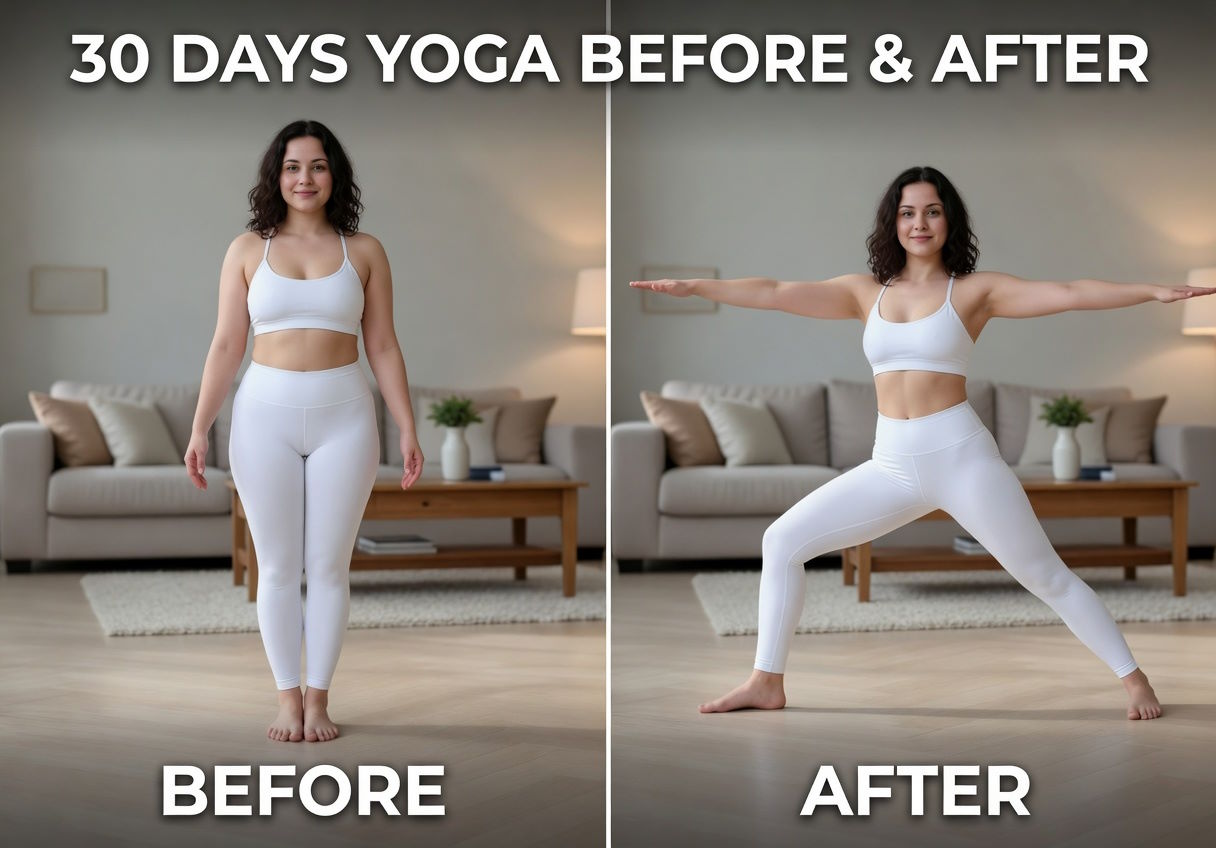
I wish I could tell you that on Day 30 I woke up transformed into some super-flexible yoga hero, effortlessly balancing on my hands, touching my toes with my forehead, body glowing with golden light.
That didn’t happen.
What did happen was quieter, but to me, it felt far more profound.
On that final morning, when I rolled out my mat, there was no negotiation in my head. No bargaining, no excuses. It was as natural as washing my face. I moved through my flow, and somewhere between a grounded warrior pose and a gentle twist, it hit me: my body felt like home again.
I still wasn’t touching my toes flat-palmed every time. My hips weren’t magically made of rubber. My balance could still be comically bad on some days, and I absolutely still toppled out of tree pose now and then. But the stiffness that once felt like armor had softened. I could fold forward and actually feel spaciousness instead of panic. I could breathe steadily through deep stretches that had once felt impossible.
My shoulders rested a little farther from my ears now.
My jaw wasn’t always clenched.
I caught myself slouching less and standing taller, like my spine finally remembered what it was built to do.
And then there was my mind.
Somehow, the daily act of pausing—even just for 15 or 20 minutes—to breathe, to feel, to listen, had created this thin but steady line of calm running through my days. I still got stressed, still worried, still had busy, chaotic thoughts. But I also had a place to return to—a rhythm of inhale and exhale that I could find even at my desk, even in traffic, even in the middle of a messy day.
By Day 30, yoga wasn’t about “getting flexible” anymore. It had become this ongoing conversation between my body and my mind. A place where I could be imperfect and still feel enough. A daily reminder that small, consistent actions—done quietly, without fanfare—can genuinely change the way you move through the world.
So, when that 30-day mark arrived, I didn’t celebrate by ending the habit. I celebrated by not stopping.
Because somewhere in those 30 days, I had shifted from stiff to stretchy in ways that had nothing to do with just muscles and tendons. My body wasn’t suddenly a gymnast’s, but it was more open, more responsive, more alive. And my relationship with myself had softened too.
If you’re anything like I was at the beginning—tight, tired, overwhelmed, convinced that your body is “just not flexible”—I’ll tell you this, not as a guru but as someone who started out unable to touch their toes:
You don’t have to be flexible to start. Flexibility is what slowly, stubbornly, beautifully shows up when you keep meeting yourself on the mat, one imperfect day at a time.
Those first 30 days didn’t turn me into a different person. They just helped me uncover a version of myself I hadn’t met in a long time—steadier, kinder, a little more stretchy in body and in spirit. And that, if you ask me, was worth every wobbly tree pose and every shaky downward dog along the way.